

“Hey, whatcha doing?”
Yeah, well, we’re doing a couple of things here and there. Wanna know more?

As mentioned in our last update, we are in a transition phase, to say the least. That doesn’t mean we’re just lazing around. Well, actually, maybe a little bit, but not so much that we’re doing nothing but reading the headlines with dread and dismay.
Let’s do a recap, maybe throwing in a few questions (or provocations) to spark a conversation; otherwise, you know, it would be better to watch some TV.
Waiting for Goblindom
Paraphrasing Beckett’s famous play, we are all waiting for Godot Goblindom, which has been stuck in the “limbo of almost-finished drafts, but I swear it’s really coming out now.” We have good reasons for the year-plus delay. Still, honestly, we don’t like blaming physical and mental health, personal problems, locusts, the geopolitical situation, and how, in general, a cruel and adverse fate1 is conspiring against our happiness.
“The thing you were waiting for hasn’t come out, and to cheer you up, I’ll tell you it hasn’t because my dog died” might even be true, but is it really necessary to add pity to our readers’ disappointment? One day, we should rethink this whole oversharing thing as a community of creators, because it’s getting a bit out of hand. The world’s full of misery as it is, right?
Getting back on track, there is finally a fully laid-out first version of Goblindom, which we are circulating among friends and contacts to gather feedback on both the gameplay loop and the language choices. We’ve received the first invaluable pieces of feedback, some of which translate to “it reads like it was written by Borat pretending to be born and raised in Chiswick, London.” We’ll improve it as much as possible before the 1.0 release.
If you want to participate in this fun little pastime, write to us privately here on Substack, and we’ll send you a PDF copy of the draft. We don’t expect or want you to send us 200 pages of corrections (even though we might need them), but an “AHAHAHAHA WHAT?!” is perfectly fine too; we’d consider that constructive criticism.
Luckily the game is fun, and we just realized it’s a great subversion of the colonial logic of classic RPGs: here, the dungeon creatures, lethal neighbors of the titular goblins, are almost literally squeezed by adventurers to turn them into useful assets for human progress. For those living on the surface, the magical creatures of the underground are nothing more than precious monster oil, a miraculous substance that can do practically anything. The goblins, even if useless and cruel, end up being the involuntary defenders of a fragile ecosystem that finds its balance in chaos.
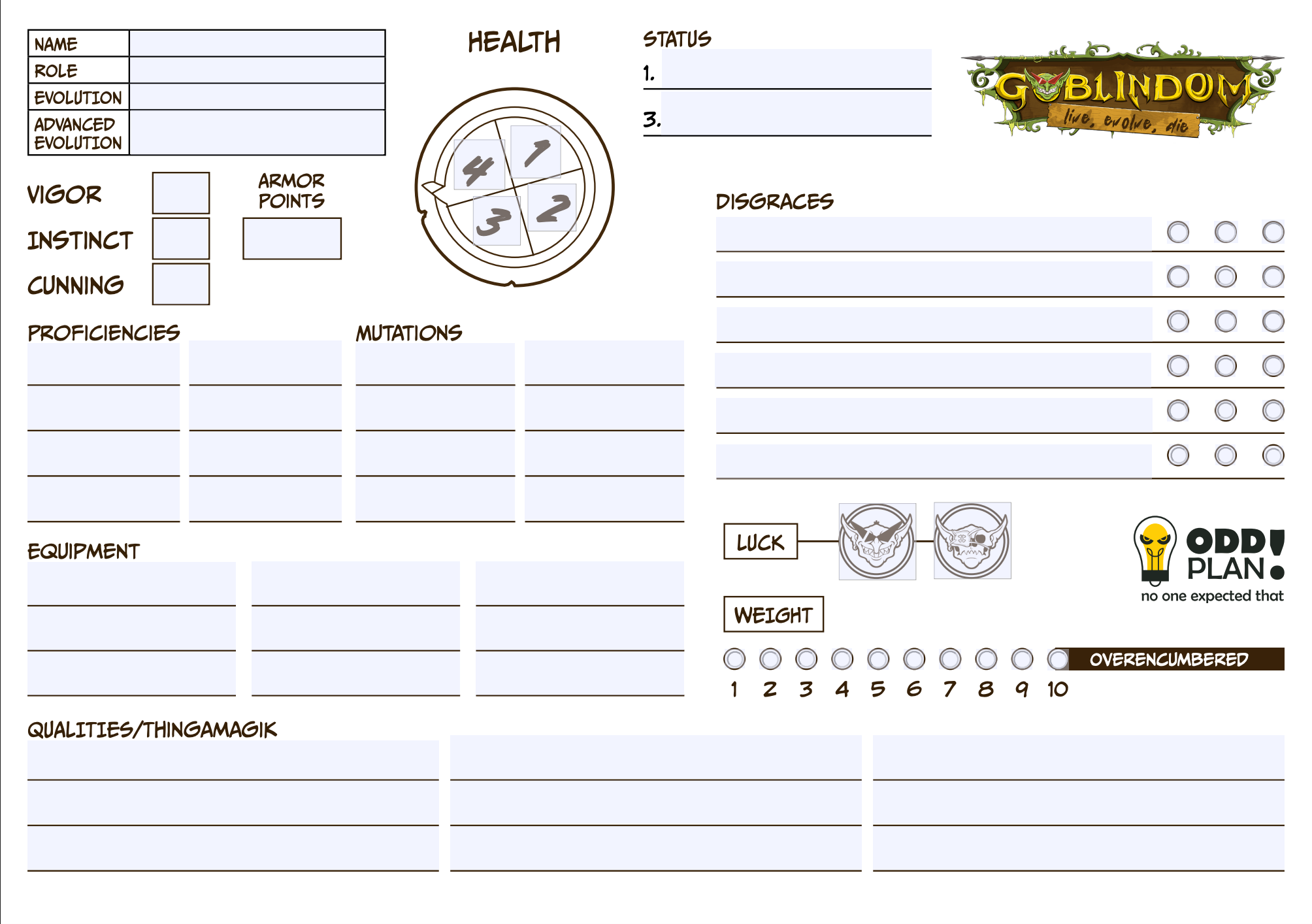
That being said, it remains a silly game, and perhaps that’s already obvious from the character sheet itself.
“20€ is too much.”
We had an interesting conversation with a friend of ours who was hunting for used poetry books, seeing as that section tends to languish more than others in bookstores. “Two hundred self-help and pop psychology books and not a single Robert Walser collection,” she complained. But then again, poetry is a precious artistic expression yet generally uneconomical, with many authors and a significant share of releases that can be traced to vanity publishing rather than to a worthy cultural project. We see a certain resemblance to the RPG sector, albeit with the fortunate distinction that at least in this space, many people still manage not to take themselves too seriously.
But the important point of the conversation was her reaction when she finally found an online volume that seemed to suit her needs: “Should you really spend more than twenty euros on a book?”
Our answer was yes, you absolutely should. Twenty euros shouldn’t even be enough if it’s a volume published by small printing businesses that cannot use economies of scale to keep prices down. And yet, given the frankly disastrous economic convergence, the cost of living is increasingly central, and culture is the first to suffer cuts when it’s time to tighten the belt.
On the one hand, we are strong supporters of accessible pricing; on the other hand, we want to avoid devaluing the book itself, regardless of its content, in a historical moment when people read less and less.
What, then, is the value of a book? Is it that different from its perceived value? How much should we charge, for example, for a role-playing game? We are clearly not talking about the best price in terms of positioning and marketing, but rather on a purely conceptual level. We honestly wouldn’t know how to answer. But the visceral reaction to rejecting “twenty euros” as too high a price makes us think it’s probably more than we would actually be willing to spend.
And then let’s throw in another variable, to up the difficulty: digital-only games. As you may know, we have some issues with paper. Not because we hate printed books, far from it! We actually like them so much that we don’t want to keep dozens of copies in a warehouse or even be forced to pulp them. That’s why we’ve been all-digital since after Epigoni, and outside of collaborations with other authors, we have no intention of doing otherwise.
And so we return to the price conundrum: how much less can a digital game or book cost than a physical copy? Yes, we can look at Amazon and get an idea. Thanks. We’d like to step outside market value and lean toward intrinsic value. How much should, for example, a Goblindom digital copy cost? Half of a hypothetical printed copy? More than half? We leave the answer to you. We will keep the price of Goblindom low in a frankly self-destructive manner, but we do have this lingering feeling that we are doing a disservice to books in general, rather than to ourselves.
Projects for the Future
The summary is quick: we want to do little, and do it well. Doing it well, not in the sense of “we want to produce Ennies-nominated games and get top honors,” but rather “each of us wants to make the game we truly want to play, over which we have absolute creative control, and where the natural desire to please people can go fuck itself.”
This means we’ll be making very personal games. Making very personal, perhaps even unpleasant games, in a collective where everyone ONLY works on each other’s projects if they find them interesting, might complicate things a bit from a production standpoint.
On the horizon, for sure, there is only Goblindom and Godnet Database, which is the expansion for Epigoni, now needing only a few more months of gestation and some copious swearing to see the light of day.
As for the rest, there are ideas, and even a few manuscripts in the drafting phase that will only deserve to be taken seriously once they have an ending… Whether it’s worthy or not, whether it’s definitive or not. We noticed that having dozens of projects and dozens of ideas stuck in our heads, left to age like game meat for years, hasn’t helped.
We have, no joke, about a hundred artworks, half a thousand pages, and dozens of ready pitches for titles that will probably never see the light of day. Good ideas, too, probably, but we’ve spun them around in our heads so much that they now seem old, trivial, and completely uninspired to us.
That’s why we have something in the pipeline, but we’re keeping it quiet. Not just with you, but also with the rest of the collective. Because we want that sense of wonder of a rough draft with a beating heart to remain intact upon the first reading.